
Scalp Micropigmentation vs Hair Transplants
When faced with hair loss, many men wonder what permanent solutions are available to restore their hairline and improve their appearance. Today, we’ll take a closer look at two popular options: hair transplantation and scalp micropigmentation.

What is a Hair Transplant?
Hair transplant surgery creates new hair through a process in which healthy hair follicles are removed from the donor site and inserted into the scalp where hair has thinned.
The two most popular methods of hair transplants are FUT and FUE. In a FUT (follicular unit restoration) hair transplant, a thin strip of hair is surgically removed from the donor region. In an FUE (follicular unit extraction) transplant, each hair graft is removed from the donor region one by one using a punch tool and then inserted into the scalp. The collected hair follicles are inserted into the areas of the scalp with baldness or thinning.
Immediately after surgery, the hair looks stubbly, and scabs appear. It takes about three months for the newly transplanted hair to start growing. As the new hair grows longer, the final result will become noticeable.
Hair Transplant Pros and Cons
Pros
- It’s a good option for those suffering minimal hair loss and enough hair to use as a donor site.
- Will provide the look of real, full hair.
- If you’ve suffered severe hair loss, there may not be enough donor area to cover all of it in a single surgery. You’d need to undergo multiple surgeries to complete the transplant, resulting in multiple transplant scars.
- Hair transplants typically take six months to a year before you start to see results.
- Hair transplants are expensive, and you may need to take time off work to heal after your surgery.
What is Scalp Micropigmentation?
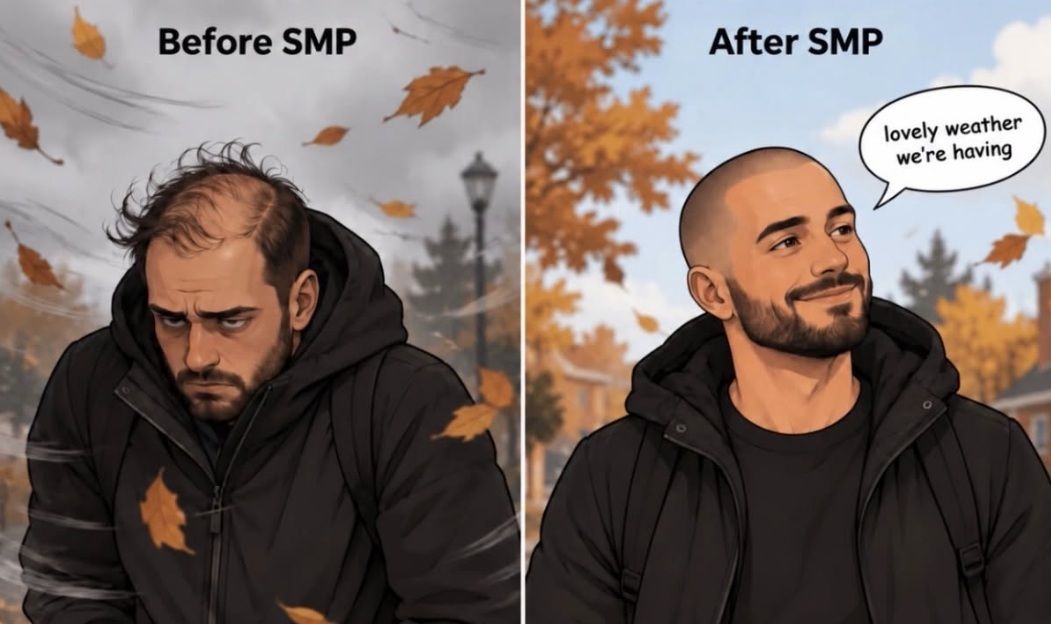
Scalp micropigmentation , also known as SMP, is a safe, non-surgical, advanced hair restoration technique. With micropigmentation, a small amount of pigment is applied to the scalp, mimicking the hair follicles, creating a natural, rich hairline. Micropigmentation can make the hair look richer, cover scars and birthmarks, or improve a hair transplant’s appearance.
Many people think of SMP as essentially a hairline tattoo. Although similar, micropigmentation is performed slightly differently than a standard body tattoo. For example, the needles’ diameter is much smaller to mimic the hair’s shape more closely. The shape of the needle is not round, but jagged, giving it a more natural look. The pigments used are also different from the pigments used in standard tattoos because they’re tailored to the recipient’s hair.
Scalp Micropigmentation Pros and Cons
Pros
- Instant results. You’ll have a new hairline and the appearance of a full head of hair right after your SMP session.
- Scalp micropigmentation doesn’t require surgery. You can go back to work within 24-48 hours.
- Scalp micropigmentation is more affordable than a hair transplant.
- Scalp micropigmentation gives you the appearance of a short buzz cut. If you want the option of different hairstyles, then a hair transplant may be the better option.
Which Hair Loss Solution is Right for You?
There are benefits to both hair transplant surgery and scalp micropigmentation. Some people choose both treatments because scalp micropigmentation can enhance a hair transplant or mask the scar at the donor site. Micropigmentation may be the best option if you’d prefer to avoid surgery and like the appearance of a buzz cut.
Suppose you’re looking to physically restore your hairline or have surgery to add fullness to your thinning hair. In that case, hair transplant surgery may be a good fit. Micropigmentation only provides the illusion of more hair, while hair transplantation replaces the lost hair with the patient’s natural hair.
Regain Your Confidence with Scalp Micropigementation from SMP Ink
The experts at SMP Ink can hook you up with a new hairline and a new hairstyle with scalp micropigmentation. We can have you feeling fresh and confident with your new look! Don’t let male pattern baldness get you down. Call us today for a free consultation!