

Historical Hair Loss Treatments

shiftframe • February 24, 2022

Hair loss has been an issue since the beginning of time. Unfortunately, in ancient times, the modern treatments for hair loss that we have today weren’t as readily available. Continue reading to take a closer look at some of the hair loss treatments utilized throughout history.

Greece

The ancient Greek physician, Hippocrates, has often been dubbed as the father of medicine. However, even doctors aren’t always right. Hippocrates actually suffered from hair loss himself. In order to cure his hair loss, he concocted a potion consisting of beetroot, horseradish, pigeon droppings, spices, and opium. The potion was a failure.

Hippocrates did have a theory about castration and the effects it had on hair loss. He noticed eunuchs didn’t seem to suffer from hair loss and attributed that to castration. Although he opted out of being castrated himself, researchers in 1995 deemed that Hippocrates’ theory was correct.

Rome

Many pictures of Julius Caesar show him wearing a laurel wreath around his head. This wasn’t just a Roman fashion statement. Caesar was plagued with advancing hair loss. Cleopatra supposedly advised him of a possible cure containing bear grease, horse teeth, and ground-up mice. However, this concoction was an epic failure. 

When he could no longer hide his hair loss by sweeping his hair over his scalp and growing it long at the back, the emperor of Rome just threw on a laurel wreath around his head instead.

Great Britain

A British solution to most emotional ailments is a cup of tea. In the 19th century, this logic was also utilized as the cure to baldness. When 19h century folk were plagued with thinning hair, they would rub Indian tea onto their scalps, along with a chunk of lemon. Obviously, this method was unsuccessful and its use quickly faded away.

Egypt

In ancient Egypt, those who were plagued with hair loss had many choices of treatments, all of which were unpleasant. According to the Ebers Papyrus, an ancient medical Egyptian text dating back to 1550 BC, there were a few accepted cures for hair loss. All cures involved a topical solution of a mixture to the scalp. These cures were porcupine hair boiled in water and left on the scalp for four days, female greyhound leg fried in oil with a donkey hoof, or a mixture of the fats from a hippo, tomcat, snake, ibex, and crocodile. 

While there is no data showing the effectiveness of the treatments, one could assume they were unsuccessful.

Modern Days

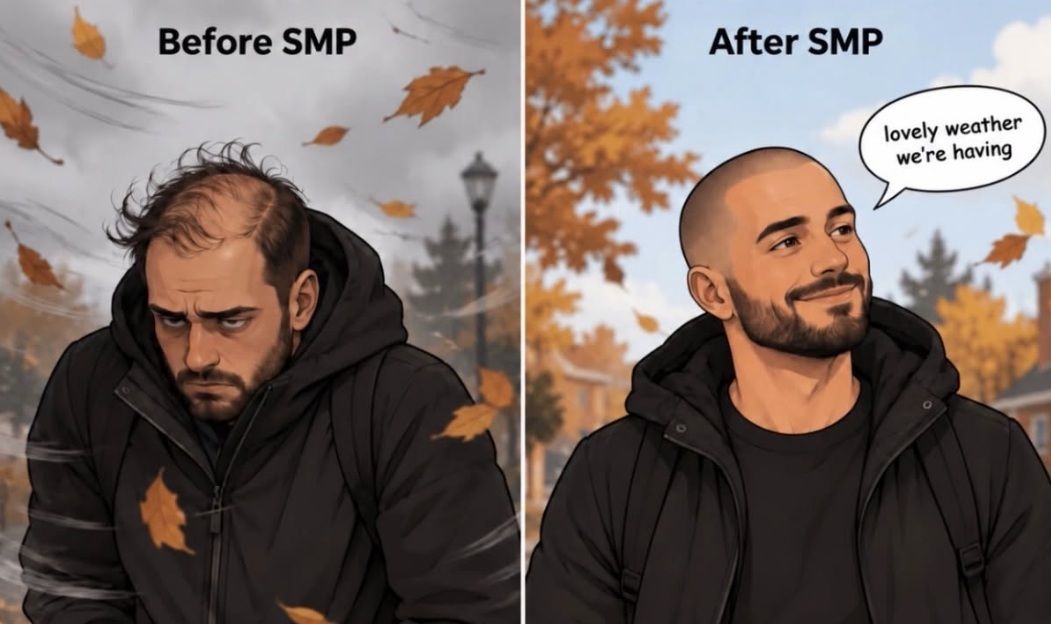
Nowadays we’re fortunate enough to have a plethora of options when it comes to hair loss solutions. We can choose from topical solutions such as minoxidil or hair transplant procedures such as FUE or FUT. More recently, there’s an even better hair loss solution that has been gaining traction. This new hair loss solution is known as scalp micropigmentation (SMP), which is a safe, non-surgical, advanced hair restoration technique that’s similar to permanent cosmetic pigmentation. 

At SMP Ink , we use the industry’s most advanced micropigmentation machines to provide our clients with superior and natural results. With over a decade of experience, our technicians will provide you with the healthy full head of hair you’ve always dreamed of. Contact us for a free consultation.

By Marvin Furrow • September 26, 2026
Can Scalp Micropigmentation Fix a Bad Hair Transplant? A hair transplant can be life-changing when it goes well. But sometimes the final result still leaves visible scars, thin areas, or uneven density. Scalp micropigmentation (SMP) can help improve the appearance of many hair transplant concerns by adding realistic pigment impressions that blend with your existing hair and reduce the contrast between the scalp and surrounding follicles. SMP does not regrow hair or physically repair a transplant. Instead, it can make certain problem areas look fuller, more balanced, and less noticeable. SMP for Low-Density Hair Transplants One of the most common concerns after a hair transplant is that the result still looks thin. Even when transplanted hair grows successfully, there may not be enough density to fully hide the scalp, especially under bright lighting or around the crown. SMP can be placed between existing hairs to reduce visible scalp and create the appearance of greater density. This is often called density SMP and can work well alongside both natural and transplanted hair. Can SMP Hide FUE and FUT Scars? Hair transplant procedures can leave different types of scarring. FUE procedures may leave small dot-like scars throughout the donor area, while FUT procedures can leave a more noticeable linear scar across the back of the scalp. SMP can help camouflage both by blending pigment into the surrounding area and reducing the contrast between scar tissue and the scalp. The scar itself does not disappear, but it can become much less noticeable, particularly with shorter hairstyles. Improving Uneven Donor Areas Some people are left with patchy or overharvested donor areas after a hair transplant. When too much scalp becomes visible between the remaining hairs, SMP can help create a more consistent appearance throughout the area. By adding follicle-like impressions where density is lacking, SMP can make the donor area look more balanced without another surgical procedure. Can SMP Improve an Unnatural Hairline? In some cases, yes. If the hairline looks thin , inconsistent, or lacks density, SMP can help soften the transition and create a fuller appearance. However, SMP cannot reposition transplanted hairs or change the direction they grow. If the issue is related to the placement of the grafts themselves, surgical correction may still be needed. SMP and Hair Transplants Can Work Together A hair transplant and SMP do two different things. A hair transplant adds real, growing hair. SMP helps create the appearance of additional density underneath and around that hair. For some people, using both treatments can create a more complete result than either one alone. SMP may also be used specifically to improve donor scars or areas where the scalp still shows through after a transplant. When SMP May Be a Good Option SMP may be worth considering if your hair transplant has left you with: Visible FUE scars An FUT strip scar Thin or low-density areas Patchy donor areas Visible scalp between transplanted hairs An uneven overall appearance The scalp should be fully healed before SMP is performed, particularly following a recent transplant. Hair Transplant SMP in Scottsdale, Arizona Every hair transplant result is different. At SMP INK AZ , we use scalp micropigmentation to help blend visible scars, improve the appearance of thinning areas, and create a more consistent look across the scalp. If you're unhappy with the appearance of a previous hair transplant, schedule a consultation with SMP INK AZ in Scottsdale to find out whether SMP can help improve your result.
marrvin furrow smp ink az owner and Mr. Universe
By Marvin Furrow • June 21, 2026
Considering SMP in Scottsdale? See why scalp micropigmentation is a low maintenance option for thinning hair, shaved styles, and summer confidence.