

The Future of Hair Loss Treatments

postlaunch • March 4, 2025

The future of hair loss treatments promises groundbreaking innovations that could revolutionize the field. Researchers and scientists continuously explore new advancements and potential solutions, bringing hope to millions affected by hair loss.

Stem Cell Therapy

Stem cell therapy is one of the most promising developments in hair loss treatment. It utilizes the power of stem cells to stimulate hair growth and regenerate hair follicles. Stem cells can develop into different types of cells in the body, making them ideal candidates for hair restoration.

During stem cell therapy, stem cells are extracted from the patient’s body, typically from the adipose tissue or bone marrow, carefully processed, and prepared for injection into the scalp. Once injected, the stem cells work by promoting the growth of new follicles and rejuvenating existing follicles. Research in Stem Cell Therapy is ongoing, but early results are promising. Clinical trials have shown significant improvements in hair density and thickness in individuals undergoing Stem Cell treatment.

Gene Therapy

Another area of research with great potential is gene therapy. By manipulating genes, scientists aim to target and reverse the genetic causes of hair loss. One vital gene therapy technology is CRISPR-Cas9, a powerful tool for precise gene editing. Researchers can stimulate hair growth and restore hair follicles by making targeted modifications to these genes. CRISPR has shown remarkable potential in various fields, and its application in hair loss treatments is no exception.

In addition to CRISPR, other gene editing techniques include zinc finger nucleases, engineered proteins designed to bind to specific DNA sequences and introduce targeted breaks in the DNA. These techniques allow for adding or removing genetic material, potentially correcting mutations that contribute to hair loss.

Virtual Reality (VR) Hair Simulation

With virtual reality, patients can visualize the outcomes of various hairstyles and hair restoration procedures before treatment. By using VR headsets, patients can virtually try on different hair lengths, colors, and even textures. VR helps patients visualize outcomes and boosts their confidence in the decision-making process, allowing them to clearly understand what to expect and reducing any doubts that may arise.

In addition to its benefits for patients, VR hair simulation also proves to be a valuable tool for hair restoration professionals. It enables them to communicate effectively with their patients through visual demonstration of potential outcomes of different treatment options.

AI in Hair Restoration?

Artificial Intelligence (AI) has revolutionized many industries and is now entering the hair restoration industry. AI algorithms can help researchers and doctors analyze hair loss patterns more effectively and develop personalized treatment plans for individuals with hair loss. AI algorithms can process vast amounts of data, including genetic information, medical history, and lifestyle factors, to identify the underlying causes of hair loss. By understanding each patient’s unique hair loss characteristics, AI can provide targeted solutions tailored to their specific needs.

Furthermore, AI can predict the effectiveness of different treatment options by analyzing a large database of hair loss cases and treatment outcomes. It can also assist in developing new treatment methods by identifying potential breakthroughs! Overall, AI in hair restoration holds great promise for the future!

The Future is Now at SMP INK

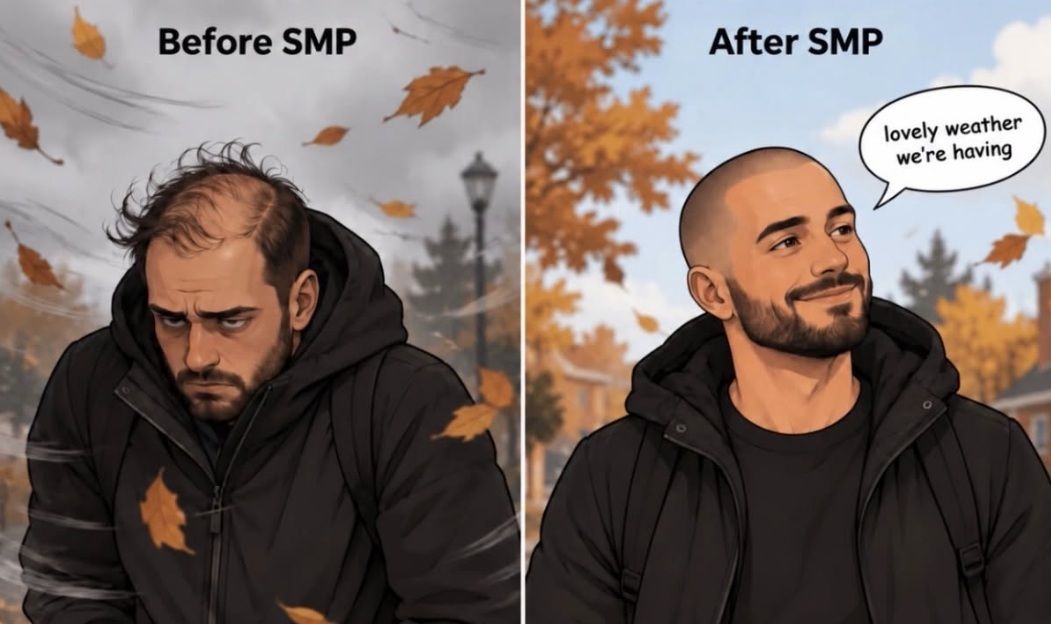
At SMP INK, you can restore your confidence through a non-surgical hair restoration technique called Scalp Micropigmentation TODAY! We can restore hairlines, camouflage scalp scars, and treat Alopecia by creating the appearance of hair follicles with permanent cosmetic pigment. Book a free consultation today!

By Marvin Furrow • September 26, 2026
Can Scalp Micropigmentation Fix a Bad Hair Transplant? A hair transplant can be life-changing when it goes well. But sometimes the final result still leaves visible scars, thin areas, or uneven density. Scalp micropigmentation (SMP) can help improve the appearance of many hair transplant concerns by adding realistic pigment impressions that blend with your existing hair and reduce the contrast between the scalp and surrounding follicles. SMP does not regrow hair or physically repair a transplant. Instead, it can make certain problem areas look fuller, more balanced, and less noticeable. SMP for Low-Density Hair Transplants One of the most common concerns after a hair transplant is that the result still looks thin. Even when transplanted hair grows successfully, there may not be enough density to fully hide the scalp, especially under bright lighting or around the crown. SMP can be placed between existing hairs to reduce visible scalp and create the appearance of greater density. This is often called density SMP and can work well alongside both natural and transplanted hair. Can SMP Hide FUE and FUT Scars? Hair transplant procedures can leave different types of scarring. FUE procedures may leave small dot-like scars throughout the donor area, while FUT procedures can leave a more noticeable linear scar across the back of the scalp. SMP can help camouflage both by blending pigment into the surrounding area and reducing the contrast between scar tissue and the scalp. The scar itself does not disappear, but it can become much less noticeable, particularly with shorter hairstyles. Improving Uneven Donor Areas Some people are left with patchy or overharvested donor areas after a hair transplant. When too much scalp becomes visible between the remaining hairs, SMP can help create a more consistent appearance throughout the area. By adding follicle-like impressions where density is lacking, SMP can make the donor area look more balanced without another surgical procedure. Can SMP Improve an Unnatural Hairline? In some cases, yes. If the hairline looks thin , inconsistent, or lacks density, SMP can help soften the transition and create a fuller appearance. However, SMP cannot reposition transplanted hairs or change the direction they grow. If the issue is related to the placement of the grafts themselves, surgical correction may still be needed. SMP and Hair Transplants Can Work Together A hair transplant and SMP do two different things. A hair transplant adds real, growing hair. SMP helps create the appearance of additional density underneath and around that hair. For some people, using both treatments can create a more complete result than either one alone. SMP may also be used specifically to improve donor scars or areas where the scalp still shows through after a transplant. When SMP May Be a Good Option SMP may be worth considering if your hair transplant has left you with: Visible FUE scars An FUT strip scar Thin or low-density areas Patchy donor areas Visible scalp between transplanted hairs An uneven overall appearance The scalp should be fully healed before SMP is performed, particularly following a recent transplant. Hair Transplant SMP in Scottsdale, Arizona Every hair transplant result is different. At SMP INK AZ , we use scalp micropigmentation to help blend visible scars, improve the appearance of thinning areas, and create a more consistent look across the scalp. If you're unhappy with the appearance of a previous hair transplant, schedule a consultation with SMP INK AZ in Scottsdale to find out whether SMP can help improve your result.
marrvin furrow smp ink az owner and Mr. Universe
By Marvin Furrow • June 21, 2026
Considering SMP in Scottsdale? See why scalp micropigmentation is a low maintenance option for thinning hair, shaved styles, and summer confidence.